
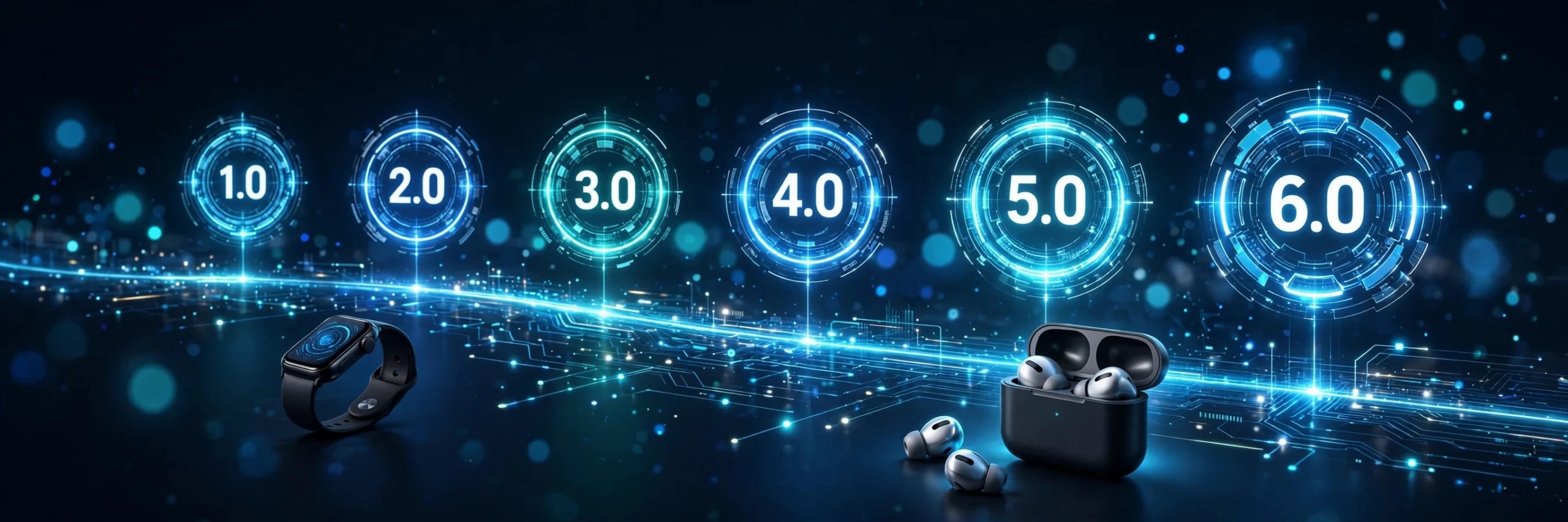
Bluetooth has changed a lot since it first launched in 1999. Early versions were slow and mostly used for basic wireless headsets. Today’s versions are faster, reach farther, use far less battery, and can even measure exact distance between two devices.
The current version most new devices ship with is Bluetooth 5.3 or 5.4, while the newest release, Bluetooth 6.0, released by the Bluetooth SIG (the organization that develops and maintains the Bluetooth standard) in 2024, introduced a genuinely new capability called Channel Sounding
In this article:
- The Evolution of Bluetooth (Quick Summary)
- Early Bluetooth: Versions 1.0 to 3.0
- Bluetooth 4.0 Series (The Shift to Low Energy)
- Bluetooth 5.0 Series (Speed, Range, and Better Audio)
- Bluetooth 6.0 (The Newest Standard)
- Are Bluetooth Versions Backward Compatible?
- Does the Bluetooth Version Matter When Buying Devices?
- Frequently Asked Questions
The Evolution of Bluetooth (Quick Summary)
Bluetooth started as a simple way to send data between two nearby devices without wires. Over time, it split into two paths. One path (Bluetooth Classic) got faster and more reliable for things like audio streaming. The other path (Bluetooth Low Energy) focused on using as little battery as possible, which is what made small wearables like fitness trackers realistic.
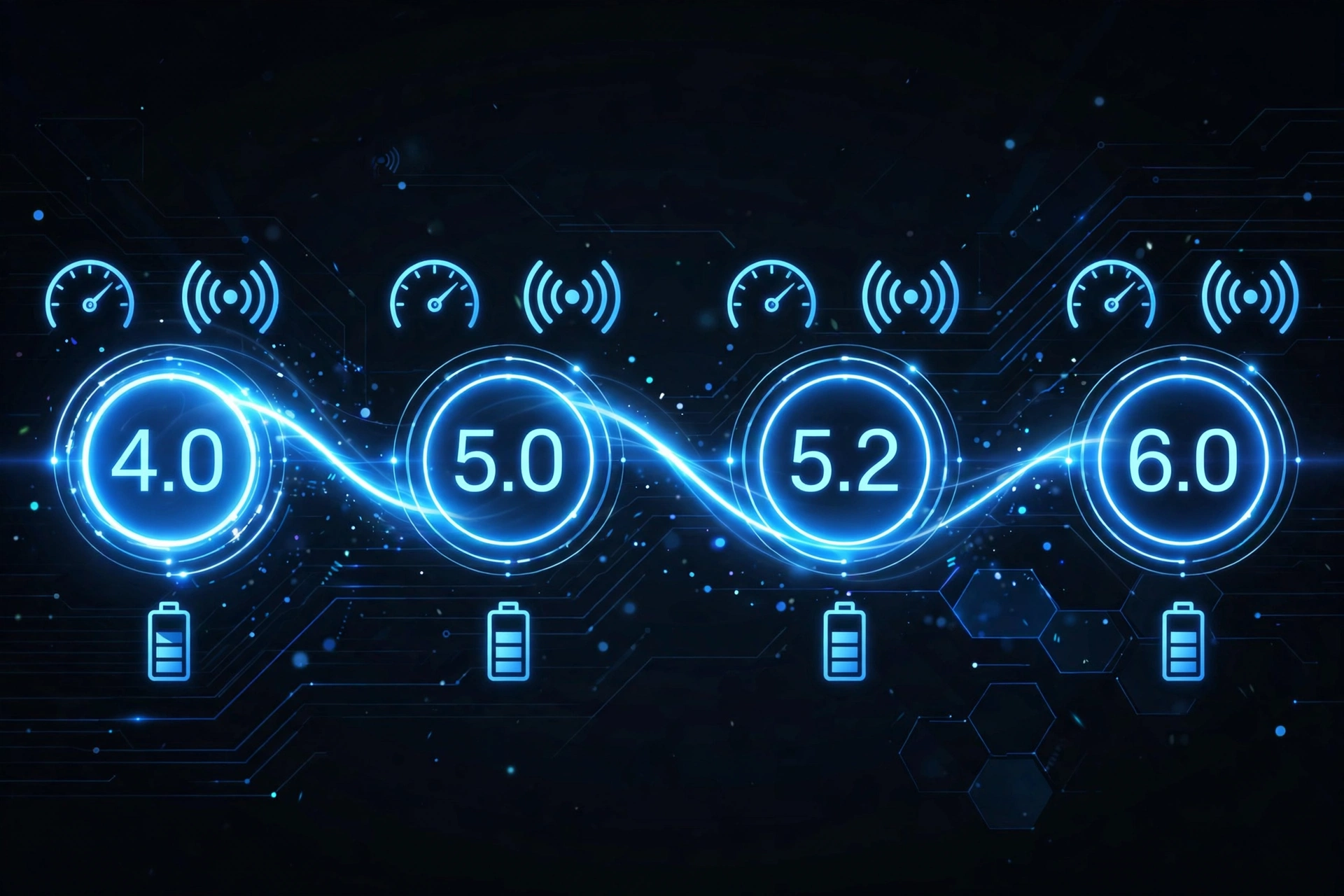
Here’s a quick look at the versions that actually matter today, Bluetooth 4.0 through 6.0.
| Version | Year | What Changed | What This Means for You |
|---|---|---|---|
| 4.0 | 2010 | BLE introduced — low-power communication | Longer battery life for wearables |
| 4.1 | 2013 | Better coexistence and connectivity — more reliable connections | Smoother device connections |
| 4.2 | 2014 | Larger packets and privacy improvements — better efficiency | Improved IoT and wearable performance |
| 5.0 | 2016 | Higher speed or longer range modes — up to 2× speed or 4× range in supported modes | Faster transfers or greater range |
| 5.1 | 2019 | Direction finding — better positioning | More precise indoor location |
| 5.2 | 2020 | LE Audio framework — more efficient audio | Better audio efficiency and Auracast |
| 5.3 | 2021 | Efficiency and connection improvements — better power management | More reliable BLE devices |
| 5.4 | 2023 | PAwR and related improvements — large-scale device communication | IoT and electronic shelf labels |
| 6.0 | 2024 | Channel Sounding — precise ranging | More accurate distance/proximity features |
If you remember only two things from this table: Bluetooth 5.2 and later is where everyday audio use genuinely improved, and Bluetooth 6.0 is the first version built for precise distance tracking rather than just connecting devices.
Early Bluetooth: Versions 1.0 to 3.0
Bluetooth 1.0, released in 1999, was the first version, and it had real problems. Connections were slow, and devices from different brands often struggled to work together properly. Bluetooth 2.0 fixed a lot of this by adding Enhanced Data Rate (EDR), which made transfers faster and more reliable. This became the foundation of what’s now known as Bluetooth Classic, the version still used today for continuous audio streaming.
Bluetooth 3.0 added an optional high speed mode that borrowed Wi-Fi for large file transfers, but almost no manufacturers actually used this feature, and it quietly disappeared from later versions.
None of these early versions matter much today. You won’t find a new device sold that only supports Bluetooth 3.0 or older, so there’s no real reason to think about them when buying something.
Bluetooth 4.0 Series (The Shift to Low Energy)
Bluetooth 4.0, released in 2010, is probably the single most important update in Bluetooth’s history. It introduced Bluetooth Low Energy (BLE), a separate mode of Bluetooth built specifically to use very little power.
Before BLE existed, keeping a Bluetooth connection active drained a battery quickly, since the connection stayed open the whole time. That’s not a problem for a phone you charge every night, but it made small battery powered gadgets impractical. BLE changed the approach entirely. Instead of holding a connection open, a BLE device connects briefly, sends a small burst of data, and goes back to sleep. This is exactly why a fitness tracker or smartwatch can run for days or weeks on a tiny battery, while an older Bluetooth Classic device streaming continuous audio drains much faster on the same size battery. If your older wired-feeling Bluetooth headphones seem to burn through battery faster than newer ones, this difference in connection style is usually the reason why.
Bluetooth 4.1 and 4.2 followed with smaller refinements: better privacy protections, support for larger data packets, and smoother behavior when a phone’s Bluetooth and LTE signal were both active at once. Neither introduced a major new capability the way 4.0 or 5.2 later did, but they made BLE more practical for real products.
Bluetooth 5.0 Series (Speed, Range, and Better Audio)
Most Bluetooth devices sold today run some version of Bluetooth 5.x. Here’s what changed at each step, and why the difference between 5.0, 5.3, and 5.4 matters less than most people assume.
Bluetooth 5.0 (2016)
Bluetooth 5.0 gave manufacturers two optional upgrades to pick from, not both at once. One mode roughly doubles data transfer speed. The other mode, officially called Coded PHY, can extend range up to four times farther, at the cost of some speed. This is a genuine trade off, and it’s decided by the manufacturer, not by you. A fitness tracker might prioritize range so it stays connected across a whole house, while a wireless game controller might prioritize speed to reduce lag. This is worth knowing because a lot of articles describe Bluetooth 5.0 as giving “double speed and quadruple range” as if you get both automatically, which isn’t accurate.
Bluetooth 5.1 (2019)
Bluetooth 5.1 added direction finding, using a technique called Angle of Arrival. This lets a device figure out not just that another device is nearby, but roughly which direction it’s in. This is the technology behind early indoor location features, like an app that can point you toward a lost item somewhere in your home.
Bluetooth 5.2 (2020): LE Audio and Auracast
Bluetooth 5.2 is behind the biggest audio upgrade Bluetooth has had in years, called LE Audio. It’s built around a new, more efficient audio codec called LC3. In practical terms, earbuds and hearing aids using LE Audio can deliver better sound quality while using noticeably less battery than older Bluetooth Classic audio, which is why newer premium earbuds increasingly advertise LE Audio support.
LE Audio also introduced Auracast, a feature that lets one device broadcast audio to an unlimited number of nearby listeners at the same time. In real terms, that could mean a gym broadcasting the audio from a TV so anyone’s headphones can tune in, or a public venue offering an audio feed to visitors wearing compatible earbuds or hearing aids. Older Bluetooth versions simply couldn’t do this, since a standard Bluetooth connection only supports one listener at a time.
Bluetooth 5.3 (2021) and 5.4 (2023)
Bluetooth 5.3 focused on making connections more stable, reducing the small random interruptions that could sometimes affect BLE devices. Bluetooth 5.4 added a feature called PAwR (Periodic Advertising with Responses), along with encrypted broadcast data. Most people won’t notice this directly, but it’s the technology that lets things like electronic price tags in stores update wirelessly and securely.
For everyday listening, gaming, and accessory use, the practical difference between 5.0, 5.3, and 5.4 is small. The version number that actually changes what you experience day to day is 5.2, because that’s when LE Audio arrived.
Bluetooth 6.0 (The Newest Standard)
Bluetooth 6.0, released in 2024, introduced a genuinely new capability called Channel Sounding. It allows two Bluetooth devices to measure the distance between each other with precision down to the centimeter level, according to the Bluetooth SIG’s own specification, under good conditions.
To put that in perspective, this is similar to the precise tracking Apple’s AirTags rely on, except Channel Sounding works using a regular Bluetooth radio instead of needing separate, dedicated tracking hardware. Possible real world uses include more accurate item trackers, and car keys that only unlock the door when your phone is genuinely close by, rather than anywhere within a wider range.
Most consumer devices haven’t adopted Bluetooth 6.0 yet, since the standard is still new and it takes time for manufacturers to build it into products. It’s useful to know about, but it’s not something you need to actively look for when buying a device right now.
Are Bluetooth Versions Backward Compatible?
Yes, but with one important catch that most articles skip over.
Newer Bluetooth versions are built to work with older ones. A phone running Bluetooth 5.4 will still connect fine to a pair of headphones from a few years ago running Bluetooth 4.2. So if you’re wondering whether your new Bluetooth 5.4 earbuds will work with an older laptop, the answer is almost always yes.
Here’s the catch. When two devices with different versions connect, the connection uses whichever version is older. So in that example, your 5.4 earbuds connecting to a 4.2 laptop will work, but the connection won’t include any features introduced after Bluetooth 4.2, such as LE Audio or the faster 5.0 speed mode. You still get a working connection, just not the newer capabilities.
This is also why a genuinely old device (roughly Bluetooth 3.0 or earlier) can sometimes fail to connect at all, since some very old Bluetooth chips don’t fully support the newer authentication and security methods that current devices expect.
Does the Bluetooth Version Matter When Buying Devices?
Sometimes, but not as much as version numbers on a spec sheet might suggest. Here’s a simple way to decide based on what you actually plan to use the device for.
- Basic music listening or hands-free calls: Bluetooth 5.0 or later is completely fine. You won’t notice a meaningful difference from a newer version number for everyday audio.
- Longest possible earbud battery life, or Auracast audio sharing: Look for Bluetooth 5.2 or later, since that’s when LE Audio was introduced.
- Hearing aids specifically: LE Audio support (5.2 or later) is genuinely worth checking for, since manufacturers are adopting it for better battery life and clearer sound in noisy environments.
- Gaming controllers or anything sensitive to input lag: The Bluetooth version number alone won’t tell you enough. Check whether the specific product advertises low-latency support.
- Precise item tracking or proximity features: Bluetooth 6.0 is built for that, though very few products support it yet.
In most cases, don’t pay extra for a device purely because it lists a slightly newer Bluetooth version. Focus on the specific feature you actually want, whether that’s battery life, audio sharing, or low latency, and check whether that exact feature is supported. Two devices both labeled “Bluetooth 5.3” can still support different optional features, so the version number alone doesn’t guarantee much on its own.
Frequently Asked Questions
What is the current version of Bluetooth?
Bluetooth 6.0 is the newest specification, released in 2024. But most phones, earbuds, and laptops sold right now still run on Bluetooth 5.3 or 5.4, since it takes time for manufacturers to adopt a new version after it’s released.
Can Bluetooth 5.0 connect to Bluetooth 4.0?
Yes. Bluetooth versions are backward compatible, so a 5.0 device will pair with a 4.0 device without any problem. The connection just runs using Bluetooth 4.0’s feature set and speed, since the two devices settle on whatever version they both support.
Is Bluetooth 5.3 better than Bluetooth 5.0?
Yes, but the improvements are incremental, not dramatic. Bluetooth 5.3 adds better handling of interference from other 2.4 GHz devices like Wi-Fi routers, stronger encryption controls, and slightly lower power use. If you’re comparing raw jumps in capability, the bigger upgrade actually happened at Bluetooth 5.2, which laid the groundwork for LE Audio.
What does Bluetooth 6.0 do?
Bluetooth 6.0’s main new feature is called Channel Sounding. It lets two Bluetooth devices measure the precise distance between them, down to centimeters. This is built for use cases like more accurate item trackers, secure car-key-in-pocket systems, and indoor location features, not for everyday audio streaming.
Do I need to buy a new phone to use Bluetooth 5.4 earbuds?
No. Bluetooth 5.4 earbuds will still pair and work with an older phone, thanks to backward compatibility. The earbuds will simply operate using your phone’s older Bluetooth version, so you won’t get 5.4-specific features like Channel Sounding, but basic pairing and audio playback will work fine.
Which Bluetooth version is best for gaming or low latency?
The version number alone doesn’t guarantee low latency. What actually matters is whether the device supports LE Audio with the LC3 codec, or a manufacturer’s dedicated low-latency/gaming mode. Bluetooth 5.2 and later give the best foundation for this, but you still need to check the specific product’s spec sheet rather than assuming a high version number means low latency.
Why do my older Bluetooth headphones drain my battery faster?
Older headphones, especially ones from before Bluetooth 4.0, typically run on Bluetooth Classic instead of Bluetooth Low Energy (BLE). Classic keeps a more constant, power-hungry connection active, while BLE was specifically designed to sip power in short bursts. Newer headphones that support BLE and LE Audio are noticeably better on battery life.

1 Comment
Pingback: Bluetooth Range: Max Distance, Walls & How to Extend It